
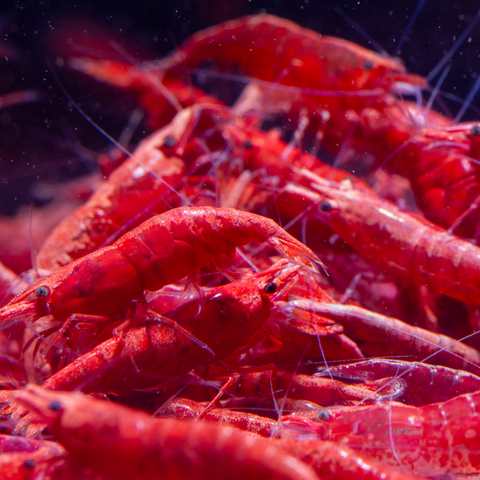
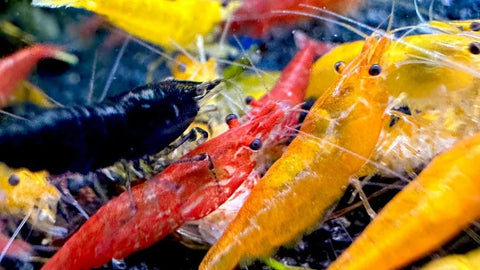
Neocaridina is the small shrimp almost everyone starts with. Red, blue, orange, green: they are all one species, Neocaridina davidi, just different colour lines. It lives one to two years, grows to 2–3 cm and forgives most beginner mistakes. Most, but not all. Below is what it does not forgive.
What water they need
Neocaridina are undemanding, but they like stability. These are the parameters we recommend: at these values shrimp keep their colour best, moult normally and breed:
- temperature 18–28 °C, ideally 22–24 °C;
- pH 7.2–7.5;
- general hardness (GH) 4–8 °dH;
- carbonate hardness (KH) 2–5 °dH.
Stability matters more than exact numbers: a shrimp lives happily at pH 7.4 if it is always 7.4, and gets sick if it is 7.0 today and 7.8 tomorrow. Our shrimp are kept in ordinary Belgian tap water, so in most tanks in Belgium and the Netherlands they settle in without special water preparation. You can check what comes out of your own tap on our water check by city page: choose your town or municipality and you will see the official GH and KH. If your water is harder than recommended, mix it with reverse osmosis water.
Copper is the main enemy
Shrimp cannot tolerate copper, even in small amounts. It can be found in some plant fertilisers, fish medicines (especially against white spot) and old copper pipes. Before you add anything to a shrimp tank, read the label. If it contains copper (Cu, copper, cuivre, koper), do not use it.
Moulting
A shrimp grows by moulting: it sheds its old shell and hides for a couple of hours while the new one hardens. An empty shell on the bottom is normal and you do not have to remove it; the shrimp will nibble it for the calcium. A bad sign is a shrimp stuck in its shell, unable to get out, with a white ring behind the head. Usually that means the water is too soft or a large water change with very different water.
Water changes
10–20 % once a week, water at the same temperature, without chlorine. Shrimp cope badly with big 50 % changes: better small and often.
Breeding
When shrimp are comfortable, they start breeding on their own. The female carries 20–30 eggs under her tail for about a month (at 22–24 °C), and then fully formed tiny shrimp hatch, with no larval stage. After 3–4 months the young are adults themselves. For the young to survive they need moss or dense plants to hide in, and no fish that will eat them.
Tank mates
Almost any fish will eat baby shrimp, and a larger fish will eat adults too. Without losses, Neocaridina are kept either on their own or with otocinclus, snails and the smallest peaceful fish, with plenty of moss. With guppies, danios and rasboras the shrimp will live, but the colony will not grow.
Where to start
Buy a group of at least 10 straight away: shrimp hide less in a group, and a group almost certainly contains both males and females. Good first choices are Red Fire (often called Red Cherry), Orange Sakura or our colour mix, the hardiest lines. Orders placed before 12:00 ship the same day, and live arrival is guaranteed.


Comments (0)
There are no comments for this article. Be the first one to leave a message!