
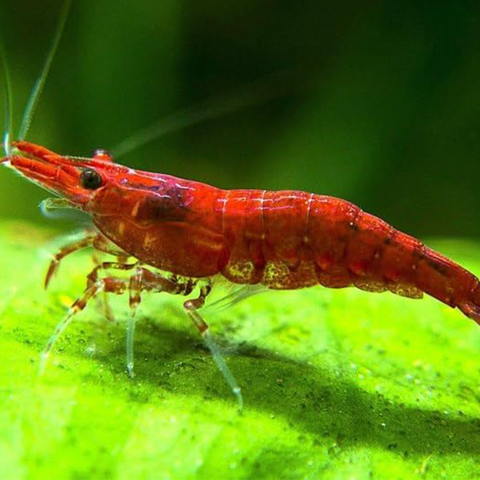
Most of the worms, white fuzz and green tufts you can find on shrimp arrive in a tank with new animals and plants. The simplest protection is a separate tank where newcomers spend a few weeks under observation. Here is how to set it up, what to check and when to move them.
Why it is worth it
In the first days lodgers are almost invisible: worms hide at the base of the antennae, and their eggs sit in the gill chamber. One new group can bring them into a colony you have been building for years. Removing them from a small tank with a few shrimp is far easier than from a large aquarium with substrate and plants.
What you need
- A separate small tank. For a group of newcomers 10–20 litres is enough.
- A sponge filter that has already been running. Bacteria live on it, so the water is stable from day one. It is handy to keep a spare sponge in the main tank in advance.
- Aeration.
- A bare bottom or a thin layer of substrate. On a bare bottom you can see moults, leftover food and any dead animals.
- A hiding place: a little moss or a ceramic tube.
- Its own net, siphon and pipette. They are never used in the main tank.
Moving them in
Acclimate the shrimp as usual; the steps are in our guide to acclimating shrimp after delivery. Do not pour the water from the transport bag into the quarantine tank or into the main tank. Keep new plants separate too, until you are sure nothing is living on them.
How long to keep them
Two to four weeks. This is an observation window, not a pass: if something new appears during this time, the period is extended. The state of the shrimp decides, not the calendar.
Every day: two minutes
- Are the shrimp eating?
- Are they moving normally?
- Are there any dead ones?
- Has anything new appeared on them?
If something looks doubtful, photograph the shrimp from the same side and compare after a few days.
Four zones to check
- The nose and the base of the antennae. This is where white, moving worms sit.

Photo: R. Maciaszek, CC BY 4.0, cropped
- The sides of the head section. White dots in the gill chamber may be worm eggs.
- The walking legs. An elongated worm with a sucker can sit here.

Photo: R. Maciaszek, CC BY 4.0, cropped
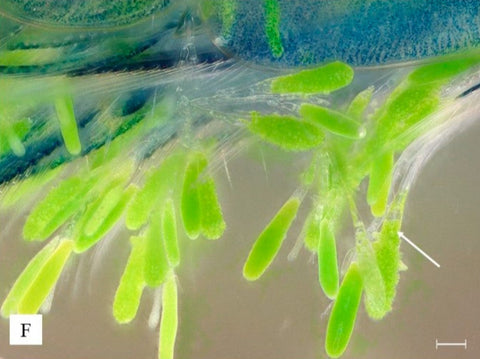
- The swimming legs and the underside of the abdomen. A green tuft here is an alga, not eggs: eggs are round and separate, the alga is threads and fluff.
Moults
Normally a shed shell can stay in the tank: the shrimp eat it. In quarantine, no. Take the moults out and look at them: worms and eggs stay on the old shell. After a moult, check the shrimp itself again too.
When they can move
- The shrimp eat and move normally.
- There are no unexplained deaths.
- Nothing new has appeared on them, including after a moult.
Move only the animals, with a net, without quarantine water and without equipment. If everything was clean, the sponge from the quarantine tank can go back into the main tank; if lodgers appeared, pour boiling water over it first.
If you find something
Compare it with the table in our article on what can sit on a shrimp and extend the quarantine. If shrimp die one after another, check the water first: oxygen, temperature, ammonia and nitrite.
What not to do
- Do not treat “just in case”. Quarantine is observation, not preventive treatment.
- Do not use fish medication. Many of them contain copper, and copper is deadly for shrimp.
- Do not share one net between the quarantine tank and the main tank.
Macro photos: R. Maciaszek, from Maciaszek et al. (2023), Animals 13(10), 1616, licensed under CC BY 4.0; the images are cropped.


Comments (0)
There are no comments for this article. Be the first one to leave a message!