
You look closely at a shrimp and see something on it that should not be there. The first impulse is to treat it at once. Take a moment first: the word “parasites” covers six quite different things, and not all of them are a disease. Some only need watching, some point to a water problem, and only a few are truly dangerous.
A lodger is not always a parasite
Many organisms simply live on the surface of a shrimp. They feed on micro-organisms and bits of organic matter, not on the shrimp itself. How much harm they do depends on three things: how many there are, where exactly they sit and what condition the shrimp is in.
Such lodgers are very common. In one study of 900 farm-bred Neocaridina, three out of four carried at least one of them.
Six things you can see
| What you see | What it is | How serious |
|---|---|---|
| 1. White moving “worms” on the nose and at the base of the antennae | Scutariella, tiny flatworms | usually harmless in small numbers; a salt dip removes them |
| 2. A longer, cylindrical worm on the legs, antennae or under the abdomen | Holtodrilus, a relative of leeches but not a leech | numbers matter: a few do no harm, many damage the gills |
| 3. White or greyish “fuzz” on the shell and legs | colonies of single-celled animals (Vorticella) | a signal: too much organic waste in the tank |
| 4. Yellow-green threads or a “brush” under the abdomen | Cladogonium, an alga and not a fungus | serious: it grows into the shell and cannot always be cured |
| 5. A small crustacean on the side of the head section, one or two | Tachaea, a true parasite | serious, but very rare in aquariums |
| 6. Milky-white muscles under the shell | a symptom, not a diagnosis | depends on the cause |
In our own practice we have met the first, the third and the fourth. The others turn up in aquariums far less often.
1. White worms on the head
Semi-transparent, elongated and moving. They sit on the nose and at the base of the antennae. Their eggs show as white dots on the side of the head section, inside the gill chamber.

Photo: R. Maciaszek, CC BY 4.0, cropped
This is the easiest case: a short salt dip helps (how to do it is described below). In our experience the worms drop off within one or two seconds, and five to ten seconds in the solution is enough.
One dip is not enough. Salt removes the adult worms, but the eggs in the gill chamber stay, and new worms hatch from them. So keep watching the shrimp and repeat the dip after a few days, until no more worms appear.
After a moult, worms and eggs stay on the old shell and spread from there. While you are treating, remove the shed shells.
2. A worm on the legs
A cylindrical body with a sucker at the end. It feeds on small creatures and organic matter on the surface of the shrimp. A few of them do no harm. It gets bad when there are many: they crawl into the gills and hinder movement.

Photo: R. Maciaszek, CC BY 4.0, cropped
3. White fuzz
This is not a fungus but attached single-celled animals. Under magnification you see little “bells” on stalks. They do not feed on the shrimp, but their appearance means too much organic waste: leftover food, dirty substrate, overcrowding.
A short salt dip often removes the fuzz, but not always and not for good. If the cause stays, the fuzz comes back. So the main thing here is less food, a clean substrate and good aeration; the dip is only a help.
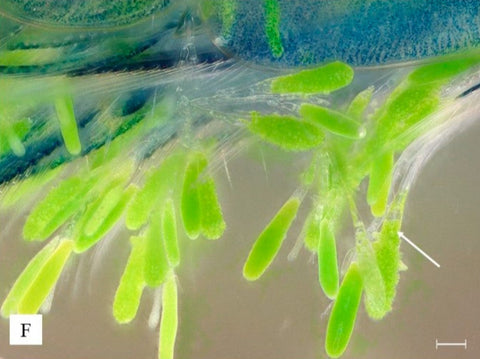
4. A green tuft under the abdomen
The most common mix-up. It is called “green fungus”, but it is an alga. And it is easily mistaken for eggs. The difference: eggs are round, even and separate from one another; the alga is threads and branching fluff.

Photo: R. Maciaszek, CC BY 4.0, cropped
Do not pull the tuft off: the alga grows into the shell, and you will injure the shrimp. After a moult it can reappear in the same place.
What to do:
- Isolate the shrimp from the others straight away.
- Salt dips. In our practice shrimp have recovered after five to seven dips. To be honest, it works in about half of the cases.
- “Black water”. Some keepers make a strong brew of alder cones or Indian almond (catappa) leaves, dark enough to colour the water, and keep the shrimp in it for several weeks. We have not tried this ourselves, but customers have told us it helps.
5. A small crustacean on the side
A small crustacean attached to the side of the head section. It is a true parasite, not a lodger. In aquariums it is very rare: it is found mostly on shrimp from natural waters.
6. Milky-white muscles
The body under the shell turns opaque and white. This is not one disease. The cause can be lack of oxygen, overcrowding, a sudden change of conditions or an infection.
If one shrimp has turned white, watch it. If they turn white one after another, the cause is in the water or an infection, and the place to start is a water test.
How to do a salt dip
- Take a cup of water from the tank (about 250 ml), not from the tap, so that temperature and water values stay the same.
- Dissolve one level tablespoon (about 15 g) of salt without additives in it: aquarium salt or plain non-iodised salt. Stir until no crystals are left.
- Catch the shrimp with a net and lower it into the solution in the net.
- Hold it there for five to ten seconds. Worms on the head drop off almost at once.
- Put the shrimp back into the tank. Pour the salty water down the sink, not into the tank.
Important:
- A dip lasts seconds, not minutes. Too long is more dangerous than too short.
- Do not dip a shrimp that has just moulted or one that is very weak.
- Caridina shrimp are more sensitive to salt: use a weaker solution for them.
- Never add salt to the main tank: the dip is done only in a separate cup.
What to do in any case
- Do not treat “just in case”. There is no single remedy for everything listed above.
- Isolate the shrimp and watch it, but only if the separate tank has the same water, temperature and aeration. A move into poor conditions is worse than living with a lodger.
- Take photos from the same side and compare them after a few days and after a moult.
- Check the tank: leftover food, the filter, aeration, ammonia and nitrite. White fuzz and white muscles most often start here. The basics are in our Neocaridina care guide.
What not to do
- Do not pour fish medication into the tank. Many of them contain copper, and copper is deadly for shrimp.
- Do not pull off the green tuft and do not scrape worms off by hand or with tweezers.
- Do not add new shrimp to a tank where something unexplained is growing on the animals.
How not to bring them in
Most lodgers arrive in a tank with new shrimp and plants. The best protection is a separate container where newcomers spend two to four weeks under observation.
Macro photos: R. Maciaszek, from Maciaszek et al. (2023), Animals 13(10), 1616, licensed under CC BY 4.0; the images are cropped.

Comments (0)
There are no comments for this article. Be the first one to leave a message!