
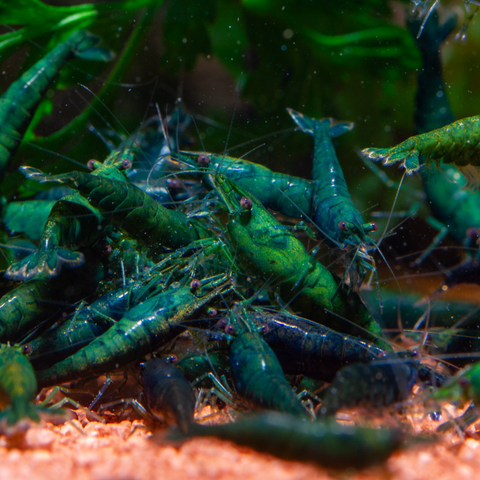
Neocaridina are known as the shrimp that breed by themselves. Most of the time that is true: a healthy group in a settled tank produces young every few weeks. If two or three months have passed and you still see no females carrying eggs, the cause is almost always one of the eight below. Go through them in order — the first three are the most common.
1. The tank is too warm
This is the most frequent cause in summer. Neocaridina breed most readily at 22–24 °C. Above 27–28 °C you will see far fewer females with eggs, and in a heatwave breeding can stop altogether. Keepers describe the same pattern again and again: no eggs all summer, then nearly every female carrying eggs a week after the heat breaks.
What to do: keep the water between 18 and 28 °C, ideally 22–24 °C. In summer, a small fan across the surface and an open lid help.
2. There are no males, or too few
Males are smaller and slimmer than females, so if you pick the largest shrimp you can easily end up with females only. A female has a wider, deeper abdomen and a “saddle” — developing eggs — visible on her back under the shell. A male stays slender.
What to do: look at the group from above and from the side. If you can only find large shrimp with a wide abdomen, add five to ten young ones from a different batch.
3. The group is too small
Six shrimp is a lottery: two males may not be enough, and a single loss changes everything. For steady breeding start with at least 10–15.
4. The tank is too clean
Shrimp graze all day on the biofilm that grows on plants, wood and glass. A new or spotless tank has none, and dry food alone is not enough: the shrimp grow and moult but do not produce eggs.
What to do: add moss, a piece of wood and some dried leaves. Once or twice a week offer blanched vegetables — cucumber, spinach, carrot — and remove what is left after a few hours. More in our guide on what to feed shrimp.
5. You top up instead of changing water
Topping up replaces evaporation but does not refresh the water: salts and waste products build up. Change 10–20 % once a week with water of the same temperature. A small change with slightly cooler water often triggers a moult, and females are ready to mate right after moulting.
Do not overdo it: a large or sudden change has the opposite effect, and a female may drop her eggs.
6. The water parameters are off
Neocaridina need moderately hard water: pH 7.2–7.5, GH 4–8 °dH, KH 2–5 °dH. In very soft water they have trouble moulting, and without a normal moult there is no breeding. You can see what comes out of your tap on our water check by city page.
Check for copper as well: it enters the water from old pipes, plant fertilisers and some fish medications, and it is dangerous for shrimp even in small amounts.
7. The young are there, but something eats them
Sometimes the shrimp do breed and you simply never see the young. Almost any fish will eat newborn shrimp, even small, peaceful species. Planaria prey on the young and on shrimp that have just moulted.
What to do: if you want offspring, keep shrimp without fish, or give them dense moss and fine-leaved plants to hide in.
8. There are too many shrimp
The opposite problem, and it is typical of small tanks. The colony breeds well at first, the numbers grow, and at some point breeding stops completely. Keepers often see this: once the population reaches a critical mass for the volume, females stop carrying eggs.

What to do: thin out the group by moving part of the shrimp to another tank, or move the whole colony to a larger aquarium.
A female dropped her eggs: is that normal?
Occasionally, yes. It happens most often with young females carrying their first eggs, and after stress: a move, a sudden water change, overheating. A female also drops unfertilised eggs — another sign that males are missing.
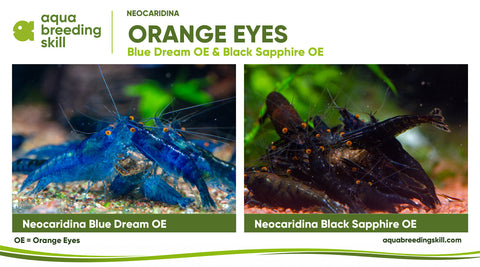
Egg colour tells you nothing: eggs can be yellow or greenish depending on the line, and it has no effect on the offspring.
How long to wait
A female carries her eggs for three to four weeks. The young hatch fully formed, about 2 mm long, and spend their first days hiding in the substrate and plants. They reach maturity in two to three months. A new group needs one to two months to settle in — before that, no eggs means nothing.
Looking for young shrimp from a different batch? See all our aquarium shrimp.

Comments (0)
There are no comments for this article. Be the first one to leave a message!