
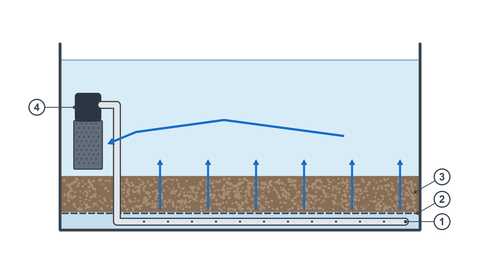
A false bottom is a grid under the substrate, with a pump feeding already filtered water beneath it. The water rises through the substrate from below and carries the dirt out of it, and the filter sponge collects it. The substrate “breathes”, no stagnant zones form in it, and it does not need siphoning.
Who needs it
Above all, tanks with active (nutrient) soil for Caridina. Such soil should not be siphoned: the granules break down. Reverse flow solves this without a siphon. For Neocaridina on ordinary gravel a false bottom is optional — an improvement, not a necessity.
How it is built

The numbers in the diagram match the list below.
- Pipe frame. A plastic tube about 16 mm in diameter, laid around the edge of the bottom and across it. Small holes are drilled in the tubes on both sides.
- Mesh. A fine plastic mesh on top of the frame (mosquito netting works). It keeps the substrate from falling through to the tubes.
- Substrate. It is poured onto the mesh.
- Pump with a sponge. The pump draws water through the sponge and feeds it into the frame under the substrate. Part of the flow can be sent to the top through a spray bar at the surface.
The main mistake: a pump that is too strong
The flow from below should be barely noticeable. Too strong a flow lifts the dirt and washes out the substrate. In the setup this article is based on, a 40-litre tank runs a 500 l/h pump, and its builder gives a separate warning: the main thing is not to overdo it.
What you get
- The water is noticeably clearer than in the same tank without a false bottom.
- The substrate does not go sour and lasts longer.
- The dirt collects in one place — on the sponge, which is easy to rinse.
Downsides
- It has to be built before the tank is started: you cannot fit a false bottom into a running tank.
- The sponge needs rinsing more often, because all the dirt goes into it.
- Plants with strong roots do not always like reverse flow.
For the other ways to filter a shrimp tank, see five filter options compared.


Comments (0)
There are no comments for this article. Be the first one to leave a message!