
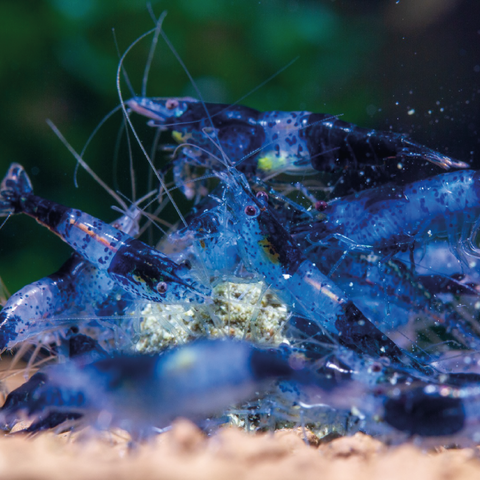
Shrimp do not need a strong filter, they need the right one. They have three requirements that fish do not: the filter must not suck in the young, the flow must be gentle, and the surface for bacteria must be large. Below are five working options, from simple to complex.
What matters for shrimp
- Protection for the young. A newborn shrimp is about 2 mm long and passes through any intake grille. The intake must be covered with a fine-pored sponge.
- Gentle flow. Shrimp graze on surfaces, and a strong current gets in their way.
- A large surface for bacteria. Shrimp are more sensitive to ammonia and nitrite than most fish.
- Oxygen. Both the bacteria in the filter and the shrimp themselves need well-oxygenated water.
1. Air-driven sponge filter
A sponge through which air from an air pump draws the water. It is the cheapest and safest option: it cannot suck in the young, the flow is weak and there is plenty of oxygen. The downside is weak mechanical cleaning: the water is biologically clean, but fine particles stay in it.

Best for: tanks up to 30–40 litres, breeding tanks and holding tanks.
2. Internal filter with a sponge
A pump with a sponge cartridge inside the tank. It clears the water more noticeably than an air-driven sponge. Choose a fine-pored sponge and a pump with some power in reserve, but soften the outflow: point it at the glass or fit a spray bar.

3. Hamburg mat filter
A corner or one end of the tank is partitioned off with a sheet of sponge, and a pump behind it returns the water to the tank. The whole area of the sponge works as a biofilter. Many experienced shrimp keepers consider it the best balance of cost, upkeep and result.

A bonus: the sponge wall becomes a pasture. Biofilm grows on it all the time, and the young sit there for days.
Upkeep is minimal: siphon the bottom behind the sponge and rinse the sponge itself once every few months.
4. Hang-on-back filter
It hangs on the tank wall, takes up little room inside and is easy to fill with media: ceramics for bacteria and, if needed, peat or carbon. A pre-filter sponge on the intake tube is a must — without it the young end up inside.

5. Canister filter
The largest volume of media and the most stable result. It is used on tanks from 60 litres and with expensive shrimp that need stable water. Take one with power and volume in reserve and soften the flow with a spray bar. The intake is covered with a sponge here too.

For media, use porous ceramics. Experienced breeders tend to avoid zeolite: it behaves unpredictably.
How not to clean the filter
Rinse the sponge and the media only in water drained from the tank: tap water kills the bacteria. Do not clean the filter on the day of a large water change — two interventions at once are extra stress for the colony. If there are two sponges in one tank, clean them in turn.
In short: what to choose
| Tank | Option |
|---|---|
| up to 30–40 l, breeding | air-driven sponge filter |
| 30–60 l | Hamburg mat filter or internal filter with a sponge |
| from 60 l, expensive lines | canister filter with a sponge on the intake, optionally paired with a hang-on-back |
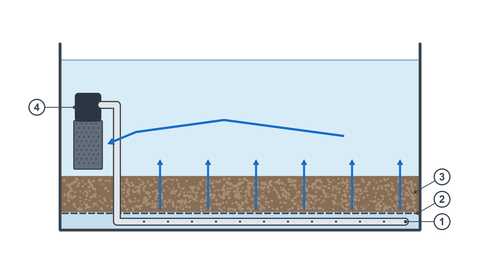
Setting up from zero? See how to set up a shrimp tank from scratch. For Caridina tanks on active soil there is one more option: a false bottom with reverse flow.

Comments (0)
There are no comments for this article. Be the first one to leave a message!