
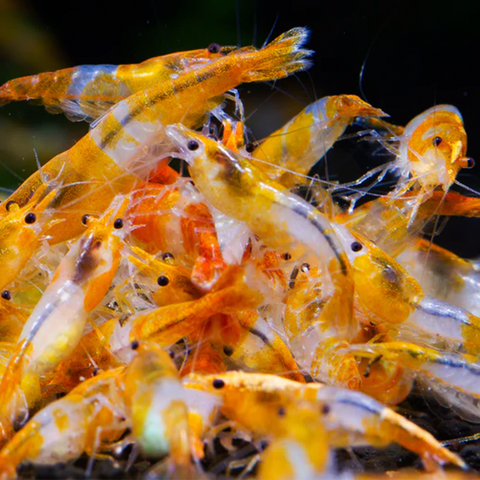
Yesterday there were ten, today you can see three, and there are no bodies anywhere. It is one of the most common questions from people who have recently started keeping shrimp. There are six reasons, listed here from harmless to serious. Check them in order.
1. They are hiding
The most common reason, especially in the first week. After a move, shrimp moult, and until the new shell hardens they stay in shelters. Finding them at this time is almost impossible.
Keepers describe it the same way: ten shrimp “vanish” in a 50-litre tank and a week later every one of them is back. In 25 litres with thirty to forty Neocaridina, only ten to fifteen are in view at any moment; the rest sit in the moss.

How to check: put some food in during the evening and shine a torch into the tank an hour after the lights go off. Even the most cautious ones come out for the smell. If less than a week has passed since you bought them, simply wait.
2. They have left the tank
Shrimp can climb out. A typical case: five Amano shrimp left a tank within two nights through a gap in the lid, climbing to the rim along a tube and a diffuser that lay at the surface. One was later found dried out in the hallway.
Out of water a shrimp dies within a few hours, so the escapees can rarely be saved.
Amano and filter-feeding shrimp escape most often, Neocaridina rarely. They do not leave for no reason, but because of stress:
- in the first nights after a move;
- after a large or sudden water change;
- when the temperature drops;
- when oxygen runs low — for example, when the filter is clogged.

What to do:
- Do not fill the tank to the brim: leave 3–4 cm to the top.
- Close the gaps in the lid, especially at the back where hoses and cables pass.
- Remember that a filter tube, a hose and a spray bar at the surface are a ladder.
- Look on the floor around the tank and behind the cabinet.
3. They were drawn into the filter
A newborn shrimp about 2 mm long passes through any intake grille. Adults get inside too — behind the sponge or into the filter housing.
How to check: open the filter. Quite often the shrimp are living inside it.
What to do: cover the intake with a fine-pored sponge. More in our guide to filters for a shrimp tank.
4. Fish ate them
Almost any fish hunts shrimp. Even small, peaceful species with a mouth “smaller than a shrimp” eat the young. A fish may leave an adult shrimp alone for months and then eat it during a moult, while the shell is soft.
What to do: if you want a growing colony, keep shrimp without fish. If you keep them with fish, provide dense moss and fine-leaved plants.
5. They die one or two a day
The most insidious reason. In unsuitable conditions shrimp do not die all at once: one or two go each day. You do not see the bodies — other shrimp and snails eat a dead shrimp within a few hours. The colony melts away unnoticed, and a month later the tank is empty.
The usual causes:
- the water parameters are wrong: Neocaridina need pH 7.2–7.5, GH 4–8 °dH, KH 2–5 °dH;
- ammonia and nitrite in a recently started tank;
- copper from old pipes, fertilisers or fish medications;
- overheating above 28 °C;
- overfeeding and rotting leftovers.
How to check: test the water and count the shrimp at feeding time for several days in a row. If the number falls, look for the cause in the water rather than buying more shrimp. You can see what comes out of your tap on our water check by city page.
Do not confuse a death with a moult. An empty shell is transparent and whole, with a split behind the head — a good sign, not a body.
6. They have grown old
Neocaridina live for about one and a half to two years. If you bought large, brightly coloured adults, some of them may already have been past their prime. For a new colony it is better to take young shrimp 1–1.5 cm long: they will live longer and produce offspring.
The order of checks
- Food in the evening and a torch an hour after lights-out.
- The filter: open it and look inside.
- The floor around the tank, the gaps in the lid, the water level.
- Water tests: ammonia, nitrite, pH, GH, KH, temperature.
- Tank mates: which fish could have eaten them.
If the colony is not shrinking but not growing either, see why shrimp do not breed.

Comments (0)
There are no comments for this article. Be the first one to leave a message!