
The shrimp that arrives at your door in a bag was most likely not born in an aquarium. Most Neocaridina for the aquarium trade are raised on outdoor farms in South-East Asia. Here is how such a farm works and why it gives shrimp what no home aquarium can.
Where the farms are
Taiwan, Thailand, Indonesia — countries where it is warm and sunny all year round. Taiwan is regarded as the world's main supplier of ornamental shrimp: one estimate cited in scientific papers is that roughly one in six comes from there. For Neocaridina it is also home ground: the species originates from East Asia.
What a farm looks like
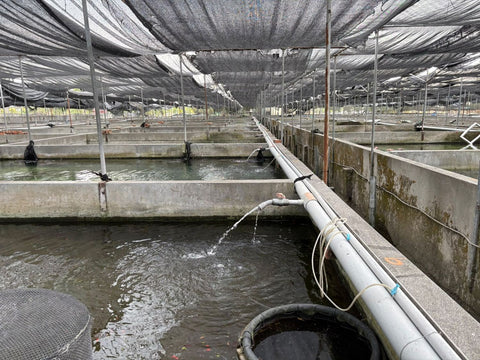
Rows of concrete ponds under shade netting. The netting diffuses direct sunlight and keeps the water from overheating.
Fresh water runs into every pond all the time in a thin stream, and the surplus leaves through an overflow. The water in a pond never stands still: it is renewed little by little, constantly.
Why one pond holds tens of thousands of shrimp
In an aquarium the number of shrimp is limited by volume: the more there are, the faster the water deteriorates. On a farm that limit is removed. The constant flow carries away everything the shrimp excrete and brings fresh, oxygen-rich water. That is why tens of thousands of shrimp live comfortably in a single pond.

Food that grows by itself
This is the main difference from an aquarium. Under the southern sun, algae grow vigorously in the ponds. Tiny creatures multiply on the algae: daphnia, moina, cyclops, infusoria. The shrimp eat both.
The result is an inexhaustible source of live food that does not have to be bought or measured out. It is in the water all the time, day and night.

Two and a half months instead of a year
On this food and in this water a shrimp grows from newborn to 2.5–3 cm in just two and a half months. In an aquarium that takes about a year.
There are three reasons, and they work together: warmth, constantly fresh water and unlimited live food.
How the shrimp are collected
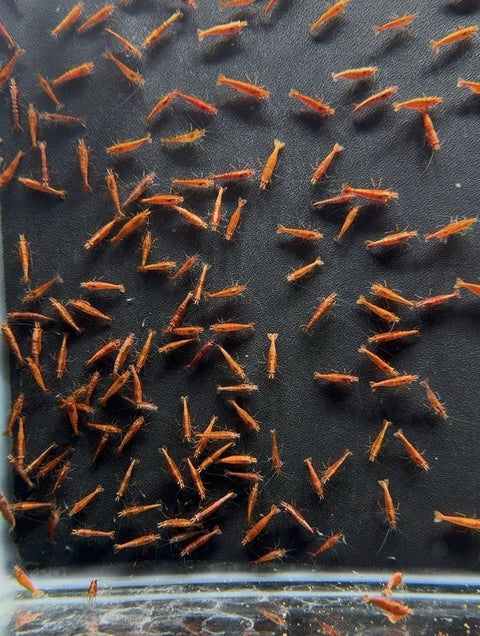
Before shipping, the shrimp are caught into net enclosures right in the pond and then sorted by colour and size.

What this means for your aquarium
A farm-raised shrimp grew up in the sun, in flowing water and on live food. At home the conditions are different, and it needs time to adjust:
- Do not rush the transfer. Move the shrimp into your water gradually, over 30–60 minutes. More in our guide to acclimating shrimp after delivery.
- They hide for the first days. This is normal: shrimp moult after a move.
- Give them a pasture: moss, wood, dried leaves. The biofilm on them replaces what the shrimp were used to on the farm.
- Keep the water stable: pH 7.2–7.5, GH 4–8 °dH, KH 2–5 °dH, temperature 22–24 °C.
We keep the shrimp in Belgian tap water before shipping them to you, so they are already used to local water. See all our aquarium shrimp.

Comments (0)
There are no comments for this article. Be the first one to leave a message!