
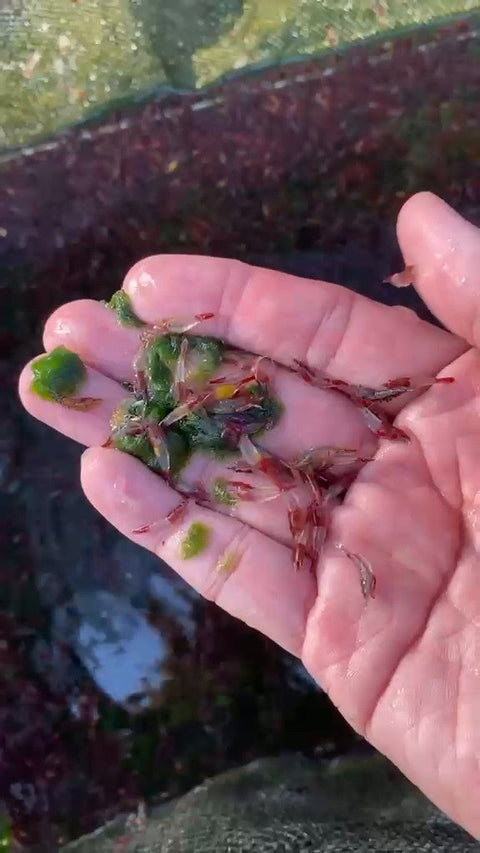
How many shrimp fit on a square metre of a farm? What are they fed, and how much? What happens to them in winter? Chinese methods for farming Neocaridina give concrete answers. We have gathered them in one place and written out separately what is useful to the owner of an ordinary aquarium.
A caveat up front: the figures below are the practice of individual farms and laboratories, not a single standard. With different water and in a different climate they will be different.
Three ways to raise shrimp
| Method | Strength | Weakness | Used for |
|---|---|---|---|
| Outdoor pond | large volume, stable water, high density | generations and lines mix, selection is hard | mass production |
| Tank with substrate and plants | a small stable ecosystem, plenty of biofilm | little space | pure lines and selection |
| Racks with shared filtration | parents and young kept apart, water under control | equipment, electricity, complex management | breeding in a small area |
The conclusion is simple: quantity is made in ponds, quality in tanks. That is why rare and expensive lines are almost always tank-raised.
How many shrimp per square metre
According to one Chinese method:
- Breeders: about 100 females per square metre, one male to three females.
- Young 0.5 cm long: 1,000–2,000 per square metre.
- Grown shrimp from 1 cm: 500–1,000 per square metre.
- Sale: from a length of 1.8 cm.
The water is only 30–40 cm deep: shrimp need bottom area, not volume.

What and how much they are fed
- Composition: 30–35 % protein, with three times as much plant matter as animal matter.
- Amount: 3–5 % of the total weight of the shrimp per day.
- Schedule: three feedings a day, the evening portion being the largest.
- The main rule: the next portion is given only when the previous one has been eaten. Otherwise ammonia and nitrite rise in the water.
Water
A quarter to a third of the water is changed once a week. The temperature is kept at 22–27 °C. Ammonia and nitrite are measured constantly: they are the first thing to get out of hand at high density.
Wintering under plastic film
The most unexpected part is winter. In northern China, Neocaridina overwinter in outdoor ponds under plastic film, and feeding stops below 13 °C. The shrimp do not grow or breed, but they survive. How far the water may cool is where we rely on our own experience: we treat 8 °C as the lower limit.
There is no need to repeat this at home. The useful conclusion is narrower: under the conditions of such a wintering, with slow cooling and no feeding, Neocaridina get through a cold period; a sudden swing is more dangerous.
What is useful at home
- Count bottom area, not litres. Shrimp live on surfaces. A low, wide tank holds more than a tall, narrow one of the same volume.
- Know how much the tank itself feeds. In an experiment with a 25-litre tank, up to 30 shrimp lived on biofilm alone, with no extra food. Once there were more than 50, the food was no longer enough.
- Feed in small portions. The farm rule works at home too: a new portion only when the old one has been eaten. More in our guide on what to feed shrimp.
- Measure the temperature in the water. Not by the heater's thermostat and not by the room temperature.
- Watch the oxygen at night. At night plants do not produce it, they consume it. In hot weather and at high density, oxygen can run short just before dawn.
For how such a farm is built, see how Neocaridina shrimp are farmed.
Sources: Xu Zhongping, 2017; Lin Shi et al., 2016; Deng Jiewen, Chen Wenyi, 2022; Li Chaoqi et al., 2018; Zhang Yuanchang et al., 2018.

Comments (0)
There are no comments for this article. Be the first one to leave a message!