
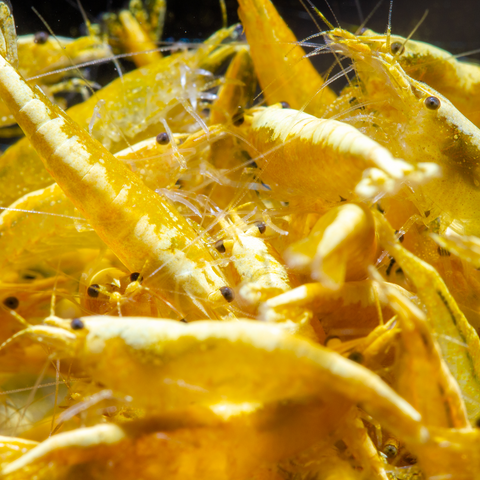
You bought bright shrimp, they bred — and the young grew up paler. A year later the colony may look noticeably plainer than on the day you bought it. Often this is not a disease or bad water but heredity without selection, although conditions also play a part. Below is how to tell one from the other and what to do.
Bright colour is the result of constant selection
The intense colour of Neocaridina is not fixed once and for all. It was obtained by selection: generation after generation, only the brightest shrimp were used for breeding and the rest were removed. A breeder does this all the time.
In a home aquarium there is usually no selection. Pale shrimp breed just as well as bright ones, so over the generations the average colour of the colony can slip down. Nobody has spoiled anything — the selection has simply stopped.
Conditions and heredity are two different things
A shrimp's colour has two parts. The first is what it is able to show: that is set by heredity. The second is what it shows right now: that depends on the background, the light and the food.
Dark substrate and good food bring the colour out in each shrimp, but they are not passed on to the offspring. Good conditions decide how a shrimp looks today; what the young inherit is decided by the parents. That is why a colony can grow paler even in ideal conditions if nobody selects.
Three reasons a colony grows paler
- There is no selection. The main reason, described above.
- Different colours are mixed. Red, blue and yellow Neocaridina are one species, and they interbreed. The offspring of such a cross are usually mixed: many drift back towards the wild colouring, brownish and semi-transparent, and the brood does not come out uniform. Getting a clean colour back after that is very hard.
- You are judging too early. The young are almost colourless and gain colour after several moults. A pale baby is not yet a pale shrimp.
How to assess colour properly
Do not look at a shrimp “as a whole”. Assess the zones separately:

- Back and shell: how dense the colour is and whether there are transparent patches.
- Underside: whether it is coloured from below.
- Legs: in the highest grades the colour reaches the legs; in middle grades the legs are pale or striped.
Assess adults, not the young. And do not write off a female that has just carried eggs: she may be paler for a while.
How to keep a line: three tanks
Breeders keep a line in three tanks:

- Breeding. Only the best-coloured adults live here.
- Young. Grown juveniles are moved here until their colour shows.
- Culls. Everyone that fell short on colour. These are ordinary healthy shrimp — fine inhabitants for a community tank.
The cycle repeats all the time: the best from the tank of young go into breeding, the rest go to the culls.
Three tanks are for those who keep a line seriously. At home a simple rule is enough: every few months, move the palest adults to another tank.
Do not select for colour alone
Experienced breeders warn: if you keep only the very brightest too quickly, the line weakens. Parents are judged on several traits at once:
- the colour is dense and even, right to the tips;
- the body is sturdy, not emaciated;
- the proportions are right, the head is not too large;
- size — with one caveat: a small shrimp is not always a weak one; in a cramped tank with little food they all stay small.
One more rule: keep a group in the breeding tank, not a single pair. The more parents there are, the longer the line stays healthy.
Fresh blood
From time to time it is worth adding a few shrimp of the same line from another source. There is no single recipe, and breeders use two approaches:
- Two groups. The line is kept in two separate tanks and the males are swapped from time to time. A male is more convenient than a female: he passes new traits to several females at once.
- Different sources from the start. The colony is put together from shrimp of one line, but from several different breeders. Then there is enough variety for a long time.
What has nothing to do with heredity
Sometimes paleness comes from conditions, not genes. Check:
- Substrate and background. Shrimp are paler on a light one. More in our article on dark substrate.
- Light. In the dark the pigment contracts, in the light it spreads. In one experiment, no food additive kept the colour of blue Neocaridina in darkness.
- Food. Red and yellow pigment comes only from food. But food does not replace selection: it helps show the colour that is there.
- Stress. After a move, in poor water or next to fish, any line turns pale.
If the conditions are fine and the colony still grows paler from generation to generation, the likely cause is a lack of selection. To compare lines and grades, see our guide to colours and grades.

Comments (0)
There are no comments for this article. Be the first one to leave a message!