
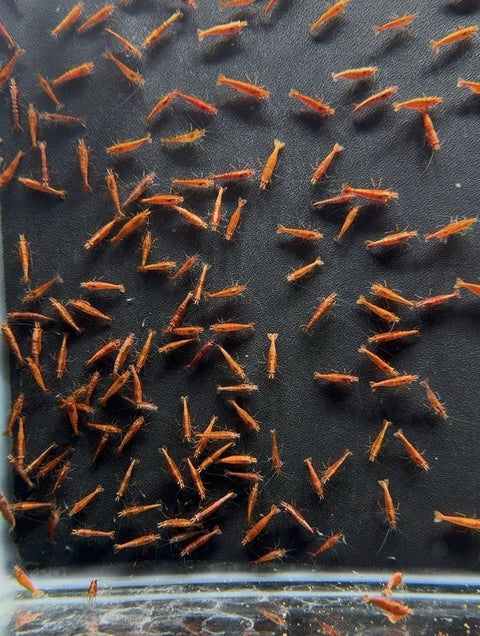
Everyone knows the advice: choose dark substrate and your shrimp will be brighter. Fewer people know that it has been tested in the lab — and confirmed. Here is what exactly was measured and how to use it.
What was tested
Study one, Argentina, 2019. Young red Neocaridina were raised for 90 days on three backgrounds: white, red and black. Females on the black background had more of the red pigment astaxanthin, and the coloured part of their shell was larger than on white or red.
The researchers also tested shelters. Their presence made no difference to colour: it is the colour of the background that matters.
The authors say it plainly: black substrate is a cheap and simple way to raise the value of a shrimp.
Study two, Indonesia, 2014. Here four options were compared for 45 days: no background, white, black and red. The study looked at growth and survival. All the shrimp survived in every option, and they grew best on the red background.
The conclusion from the two studies together: in the first, black gave the best colour in the red females that were examined. In the second, over 45 days all the shrimp survived on every background, and they grew most on red. Neither study found harm from the background colour.

Why it happens
A shrimp's shell contains pigment cells called chromatophores. The pigment in them can gather into a dot or spread across the whole cell. On a light background it contracts and the shrimp turns pale. On a dark one it spreads and the shrimp becomes brighter.
This is camouflage: on a light bottom a brightly coloured animal is easy for a predator to spot.
There is a second, slower effect. After 90 days, females on the black background had a higher total astaxanthin content and a larger coloured area of the shell. The amount of pigment in the shell itself and how fast it built up were not measured separately.
How to use it
- Choose dark substrate: black or dark brown.
- Make the back wall dark too. Black film on the rear glass makes the surroundings darker; the studies did not test the back wall separately.
- Do not judge a shrimp in the bag. In a clear bag or a white bowl it always looks paler than it will in the tank.

What substrate cannot do
A dark background brings out the colour a shrimp has, but it does not add what is not there.
- Line and grade. The ceiling is set by heredity: a Red Cherry will not become a Bloody Mary on any substrate.
- Food. A shrimp cannot make red pigment itself — it comes only from food. More in our guide on what to feed shrimp.
- Conditions. Under stress, in poor water or right after a move, even the brightest line turns pale.
Which colours it works for
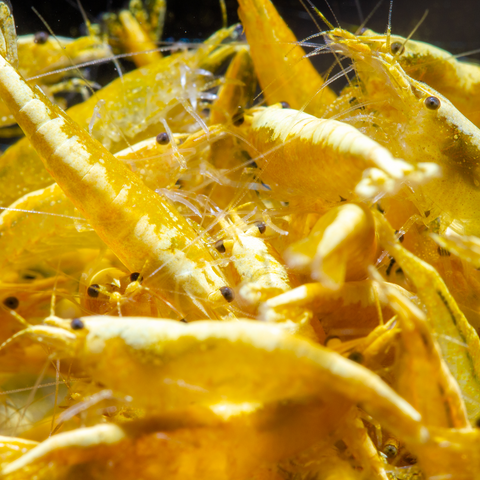
The studies were done on red Neocaridina. In practice the same holds for orange, blue and black lines. Yellow and white shrimp do not become more saturated on dark substrate, but they stand out more against it. To compare the lines, see our guide to colours and grades.
Sources: Tomas, Sganga, López Greco, Journal of the World Aquaculture Society, 51(3), 775–787; Al-Kauniyah: Jurnal Biologi, 7(1), 35–39.

Comments (0)
There are no comments for this article. Be the first one to leave a message!