
Snails in an aquarium are either helpers or a headache. Some neatly clean the glass and stones, others take over the whole tank within a month. The difference is the species. Below are the snails we keep and sell, and the ones better not to keep.
Why have snails at all
Snails eat the leftover food that fish and shrimp did not find, scrape algae film off the glass, stones and leaves, and loosen the substrate. In a small tank two or three snails noticeably reduce the cleaning work.
Clithon: glass cleaners
Small, 1–1.5 cm, with bright shells: in Clithon sp. Fancy Pink they are pink with a pattern. They constantly crawl over the glass, stones and leaves and eat the film. The main advantage: they do lay eggs, but in fresh water nothing hatches from them. The white dots of the eggs are visible on stones, but there will be no snail invasion.

Tylomelania: the most striking
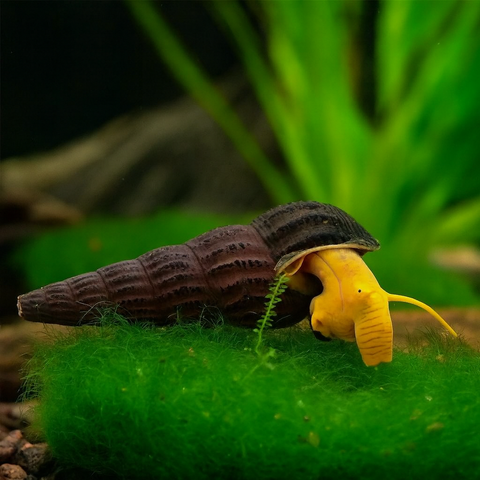
Tylomelania come from the lakes of the island of Sulawesi. They have long spiral shells and a brightly coloured body: in Orange Tylomelania it is bright orange. We also keep another variety, Tylomelania Choco. These are snails for enthusiasts: they need warm water at 26–30 °C and a pH above 7. In a cool tank they become sluggish and live shorter. They breed slowly, giving birth to one large snail at a time, so they cannot take over the tank.
Assassin snail (Clea helena): against snail outbreaks
If small snails have multiplied in your tank (bladder snails, ramshorns, Malaysian trumpet snails), the assassin snail solves the problem without chemicals. It hunts other snails and leaves plants alone. It usually leaves adult shrimp alone too. When the "pests" run out, the assassin calmly switches to leftover food. It breeds slowly itself.

Which snails not to add on purpose
Bladder snails, ramshorns and small Malaysian trumpet snails usually get into the tank on their own, on plants. They are not harmful in themselves, but when overfed they multiply explosively. The best prevention is not to overfeed. If it is already too late: assassin snails and catching them by hand (a piece of cucumber overnight, then collect the snails from it in the morning).
What snails need
- calcium for the shell: in very soft water shells get thinner and turn white;
- no copper: like shrimp, snails cannot tolerate medicines and fertilisers containing copper;
- a lid or a gap between the water and the rim: some snails climb out of the water.
We ship snails the same way as shrimp: in an insulated box, with a heat pack in winter and cooling in summer, with a live arrival guarantee.

Comments (0)
There are no comments for this article. Be the first one to leave a message!