
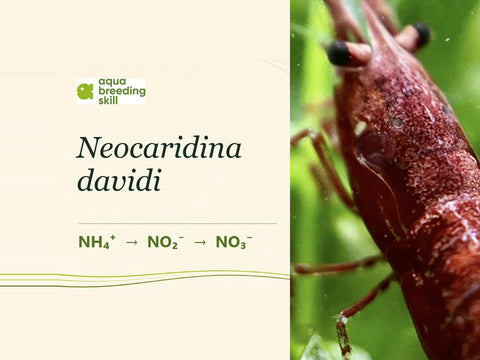
The biofilm on filter media, plants and other surfaces keeps a shrimp tank working. Its microorganisms transform nitrogen waste, break down organic matter and interact with the shrimp. A bottled culture can support a particular function. The result depends on the strain, its viability, the dose, how it reaches the aquarium or the animal, and the conditions in the tank. Before choosing a product, decide what you want to change and how you will measure it. A mature filter, aeration, water changes and regular tests remain essential.
This review covers freshwater systems: ornamental Neocaridina davidi, the freshwater prawns Macrobrachium nipponense and Macrobrachium rosenbergii, tilapia, freshwater biofilters and research from China and Thailand on photosynthetic bacteria. Marine shrimp are outside its scope. Findings in fish and other crustaceans provide indirect evidence for cherry shrimp. Manufacturer descriptions and independent trials answer different questions. Experimental doses describe the research and are not dosing instructions for home aquariums.
Different microorganisms do different jobs
Nitrifiers obtain energy by oxidising inorganic nitrogen compounds. Heterotrophs break down proteins, fats and carbohydrates, releasing nitrogen compounds again during mineralisation. Probiotics can influence the host or the microbial community in the water through enzymes, competition for resources or changes in the gut microbiota. Denitrifiers can turn nitrate into nitrogen gas under suitable oxygen-free conditions. The word “bacteria” on a label tells you little about which of these processes to expect.
If ammonia rises, the priorities are oxygen, surfaces for a biofilm and microorganisms that oxidise ammonia and nitrite. If detritus accumulates, decomposition consumes oxygen and can temporarily release more nitrogen. For a digestive effect, both the strain and how the animal receives it matter. In an ordinary shrimp tank, water changes and growing plants are the most predictable ways to manage nitrate. Deliberately creating an oxygen-free zone carries a risk of hydrogen sulphide.
| Group | Function | Limit |
|---|---|---|
| Ammonia oxidisers: AOB, AOA and comammox Nitrospira | Oxidise ammonia to nitrite. Comammox can carry the process through to nitrate. | Establishment takes oxygen, alkalinity, surface area and time. |
| Nitrite-oxidising bacteria (NOB) | Convert nitrite to nitrate. | Nitrobacter does not dominate every freshwater filter. |
| Heterotrophs | Break down uneaten food, waste and dead tissue. | Breakdown produces intermediate compounds and does not remove all nitrogen. |
| Probiotics in feed or water | May influence digestion and microbial communities. | Effects vary with the strain, host and conditions. |
| Photosynthetic bacteria | Use light and a range of organic or inorganic substrates. | Effects on growth and survival depend on the species. |
| Denitrifiers | Convert nitrate to nitrogen gas under suitable conditions. | A well-aerated shrimp tank does not automatically support this process. |

What makes a mature biofilter work?
Feed, excreta, dead tissue and dissolved organic matter continually introduce nitrogen into a closed aquarium. Microorganisms oxidise ammonia to nitrite and then nitrate. A study of 38 freshwater aquarium biofilters detected comammox Nitrospira in all 38. They dominated in 30 samples. Ammonia-oxidising archaea occurred in 35 and dominated in seven. A mature filter hosts a community of nitrifiers and heterotrophs. [2]
An earlier aquarium study linked nitrite oxidation mainly to Nitrospira-like bacteria. Nitrobacter was not the dominant group. A label listing Nitrosomonas and Nitrobacter therefore describes only part of the picture. The filter needs an established biofilm, surface area, oxygen, alkalinity and a regular nitrogen supply. Sterilising the filter or replacing all its media at once removes much of that working community. [1]
| Part of the system | Role | Practical action |
|---|---|---|
| Filter media and aquarium surfaces | Provide a place for biofilms to grow. | Retain some mature media when cleaning. |
| Oxygen | Supports aerobic nitrification and the animals. | Maintain aeration, particularly after excess organic matter enters the tank. |
| Alkalinity and KH | Provide buffering capacity for nitrification. | Monitor KH as well as pH over time. |
| Regular, moderate waste load | Sustains microbial activity. | Avoid overfeeding and sudden increases in stocking density. |
| Time | Allows the community to establish. | Clear water and a lack of odour do not show that cycling is complete. |
What was actually tested in cherry shrimp?
Kaya and colleagues studied 270 red cherry shrimp for 30 days in 27 tanks of 10 litres, with nine treatments and three replicate tanks per treatment. The control received the base diet. Other diets contained galacto-oligosaccharides (GOS) alone or with Bacillus clausii. The G2P diet contained 2 g of GOS and 1 ml of the commercial probiotic Enterogermina per kilogram of feed. Final mean weight in G2P reached 0.454 g in males and 0.716 g in females, compared with 0.404 g and 0.613 g in the controls. Growth and several feed conversion measures differed significantly between treatments. [4]
This is direct evidence for a particular dietary synbiotic in Neocaridina davidi. It was a short laboratory trial involving one commercial probiotic and a prebiotic. The shrimp ate the supplement. It was not added to the water. Female survival did not differ significantly between treatments. Only some male treatment groups showed a significant survival advantage. The trial did not test ARKA products, so it cannot establish that TheraP increases shrimp weight or that Special Blend improves survival.
| After 30 days (mean ± SD) | Males · Control | Males · G2P | Females · Control | Females · G2P |
|---|---|---|---|---|
| Final weight (g) | 0.404 ± 0.047 | 0.454 ± 0.048 | 0.613 ± 0.046 | 0.716 ± 0.039 |
| Weight gain (g) | 0.167 ± 0.058 | 0.269 ± 0.063 | 0.371 ± 0.064 | 0.474 ± 0.056 |
| Feed conversion ratio (FCR) | 2.617 ± 0.215 | 1.820 ± 0.072 | 2.847 ± 0.243 | 1.797 ± 0.148 |
| Survival (%) | 73.33 ± 23.09 | 86.67 ± 23.09 | 80.00 ± 20.00 | 100.00 ± 0.00 |

Evidence from other freshwater species
In a 28-day Chinese study, adding Bacillus coagulans to recirculating water for Macrobrachium nipponense was associated with lower nitrogen and phosphorus measurements, changes in gut microbiota and improved survival after exposure to Aeromonas hydrophila. The study compared a control with three concentrations, from 10⁵ to 10⁷ CFU/ml. Survival after the challenge reached 60% in group A3. Responses varied with concentration. These were freshwater prawns, not ornamental cherry shrimp, and the study did not test ARKA. [5]
In a 120-day trial with Macrobrachium rosenbergii, a bacterial consortium isolated from the prawn gut was associated with a mean ammonium concentration of 0.28 mg/l versus 0.36 mg/l in the control. Final mean weights were 3.92 g with the host-derived consortium, 3.17 g with the commercial mixture and 2.31 g in the control. [6]
In tilapia, different commercial water probiotics reduced ammonium by about 55–70%, improved growth measures by 12.2–28.2% and reduced FCR by 19.5–37.2%. The products differed in effectiveness. A separate 60-day study reported significant reductions in total ammonia nitrogen (TAN) and un-ionised ammonia with AquaStar Pond. [7] [8]
| Study | Observation | Interpretation |
|---|---|---|
| Macrobrachium nipponense | Changes in nutrients, gut bacteria and survival after a bacterial challenge. | A possible benefit in freshwater prawns. The experimental dose cannot be transferred to aquarium products. |
| Macrobrachium rosenbergii | The host-derived consortium lowered ammonium and improved final weight relative to the control. | Strain origin and compatibility with the host matter. |
| Tilapia | Some products improved water and growth measures. | Results depend on the product and the conditions. |
| Chinese review of aquaculture probiotics | Groups included Bacillus, lactic acid bacteria, photosynthetic bacteria and nitrifiers. | The mechanisms differ. Safety and testing in live animals matter. [9] |
Can bottled starters cycle a tank immediately?
A 14-day independent trial compared five starter products in controlled freshwater aquariums. Four products did not significantly reduce TAN relative to baseline. Only Tetra SafeStart Plus produced a significant reduction. Nitrite did not differ significantly between treatments. The researchers cautioned against relying on a starter alone to establish the nitrogen cycle. One trial cannot say how a product will perform in every aquarium. [3]
A Chinese freshwater aquarium study found lower ammonia, nitrite and chemical oxygen demand with an experimental nitrifying mixture than in controls. Ammonia and nitrite oxidisers also established earlier. The mixture, its viability, storage and trial design all affect the outcome. A starter may support cycling. Test ammonia and nitrite over time before stocking shrimp, even if the water already looks clear. [14]
| Test | Finding | Limit |
|---|---|---|
| Five starters over 14 days | One significantly reduced TAN. | Immediate cycling was not a consistent outcome. |
| 38 freshwater biofilters | Comammox Nitrospira occurred in all 38 and dominated in 30. | An established biofilter is more complex than a list on a bottle. [2] |
| Commercial Nitrobacter mixture (1998) | Nitrospira-like bacteria developed and the outcome was mixed. | A strain on a label cannot predict filter performance. [1] |
| Experimental nitrifying mixture (China) | TAN, nitrite and chemical oxygen demand were lower than in controls. | This result applies to the preparation tested. [14] |
Why the photosynthetic strain matters
Photosynthetic bacteria differ in their metabolism and in the compounds of carbon, sulphur and nitrogen they can use. A Thai study compared Rhodobacter sphaeroides, Rhodopseudomonas palustris and Rhodopseudomonas faecalis PA2 as food for the freshwater fairy shrimp Streptocephalus sirindhornae. Growth and survival were best with Rhodopseudomonas faecalis PA2. All animals in the Rhodobacter sphaeroides group had died by day 12. Fresh bacterial suspensions performed better than dried preparations. Both the strain and the form mattered. [10]
ARKA describes Special Blend as a mixture containing purple non-sulphur bacteria, purple sulphur bacteria, heterotrophs and nitrifiers. This gives a biological rationale for discussing organic matter and nitrogen and sulphur cycling. The studies reviewed here do not include an independent trial of Special Blend in Neocaridina davidi. They cannot establish that it reproduces the PA2 result, eliminates cyanobacteria, improves plant growth or makes water changes unnecessary. [11]
| Freshwater evidence | Open question |
|---|---|
| Some photosynthetic bacteria can serve as food and affect growth and survival. | Will that strain help ornamental cherry shrimp? |
| Fresh and dried preparations can perform differently. | How many organisms remain viable after storage and transport? |
| Different species produced different outcomes. | Do products labelled as photosynthetic bacteria share the same effect? |
| The manufacturer lists several groups in Special Blend. | Independent evidence for an effect in Neocaridina is still lacking in this review. |
Detritus, oxygen and hydrogen sulphide
When heterotrophs break down uneaten food and other waste, visible debris may decrease while oxygen demand rises and more nitrogen becomes available. If the tank has been overfed or something is decaying, remove the source, reduce feeding, maintain aeration and change water as needed. Cloudiness after an excessive dose is not proof that the aquarium is stabilising.
Some microbes convert nitrate to nitrogen gas where oxygen is absent. Others transform sulphur compounds. Deliberately creating a deep oxygen-free zone in a shrimp tank risks producing hydrogen sulphide. A rotten-egg smell, sudden deaths or rapid deterioration calls for immediate attention. Check oxygen and water parameters, restore aeration, change water and address the source of the problem.
| Situation | What may be happening | Priority |
|---|---|---|
| Uneaten food | Mineralisation adds to the nitrogen load. | Remove leftovers, adjust feeding and change water. |
| Cloudiness after dosing | The organic or bacterial load may be too high. | Check aeration and water parameters before adding anything else. |
| Smell of hydrogen sulphide | Oxygen depletion and toxicity are possible. | Aerate, change water, address the source and check the animals. |
| High nitrate | Denitrification needs specific conditions. | Use water changes and plant growth. Avoid deliberately creating anoxia. |
| Sudden deaths | A bacterial supplement cannot diagnose the cause. | Check ammonia, nitrite, oxygen, temperature and possible contaminants. |
Three ARKA products, three intended uses
ARKA describes Special Blend as a mixed culture for water biology and organic matter, TheraP as a probiotic care product for aquarium animals, and Nite-Out II as a starter for ammonia and nitrite oxidation. Choose according to the function you need. These descriptions come from the manufacturer. They do not independently establish efficacy in Neocaridina. [11] [12] [13]
TheraP is a care product. An established infection needs diagnosis and appropriate treatment. This research does not establish improvements in colour, stress tolerance, immunity or disease prevention in shrimp. Claims about cyanobacteria, nitrate removal or plant growth with Special Blend also need evidence under the conditions in question. With Nite-Out II, use ammonia and nitrite measurements to assess progress rather than assuming the tank will be ready in a day.

| Product | Intended use | How to assess it |
|---|---|---|
| Special Blend | Water microbiology, detritus and organic matter. | Follow the current label and track water measurements. |
| TheraP | Probiotic care for aquarium animals. | Seek a diagnosis if an animal is ill. |
| Nite-Out II | Support during cycling and nitrification. | Test ammonia and nitrite before deciding the tank is ready. |
| All three | Each serves a different purpose. | Check current instructions before combining products or changing the dose. |
Special Blend and TheraP are in stock in our shop, in the Water Care section.
A practical routine for the shrimp tank
Start with measurements. At our farm, we keep Neocaridina at pH 7.2–7.5, GH 4–8 and KH 2–5. ARKA specifies a minimum of 3 °dKH for Nite-Out II. At 2 °dKH our water falls below that minimum. Oxygen and suitable filter surfaces matter as well. Before dosing, record ammonia, nitrite, nitrate, pH, KH and temperature. Keep mature media when cleaning the filter. If shrimp are already in distress, stabilise the tank immediately. [13]
Change one variable at a time: one product, one purpose and a series of measurements. For routine monitoring, test again after about 24–48 hours and follow the trend. Observe the shrimp alongside the water tests. Check the current label for compatibility with UV, ozone, pesticides, algaecides and medicines. Instructions may change. Research doses used in other species or with other preparations are not directions for ARKA products.
| Step | Action | Decision |
|---|---|---|
| 1. Establish a baseline | Record water readings and the condition of the shrimp. | Which problem needs attention? |
| 2. Stabilise the aquarium | Remove excess organic matter, check aeration and change water if needed. | Has the immediate stress on the system decreased? |
| 3. Choose a function | Identify whether the aim is waste breakdown, animal care or nitrification. | Does the product address that purpose? |
| 4. Apply | Use the current label and introduce one change at a time. | Avoid overdosing or combining incompatible treatments. |
| 5. Monitor | Repeat routine tests after 24–48 hours and continue monitoring. | Is there a measurable change beyond appearance or odour? |
| 6. Reassess | If conditions worsen, return to basic husbandry instead of increasing the dose. | Give the animals' immediate needs priority. |
How strong is the evidence?
Freshwater biofilters contain complex communities that process ammonia and nitrite. A particular dietary synbiotic improved growth in one 30-day cherry shrimp trial. Other strains and consortia improved water or production measures in certain freshwater prawns and tilapia. Starter trials found differences between products, and photosynthetic bacteria produced sharply different outcomes across species and preparations.
| Evidence | Supported conclusion | Limit |
|---|---|---|
| Direct cherry shrimp trial | One dietary synbiotic improved growth under the trial conditions. | The result cannot be claimed for every bacterial supplement. |
| Other freshwater prawns and fish | Some strains reduced ammonium or improved performance. | A home aquarium may need different conditions and may respond differently. |
| Freshwater biofilter studies | Nitrification depends on the community and its environment. | Two familiar bacterial names do not describe the whole process. |
| Independent starter trials | Products differed in effect. | Immediate cycling is not guaranteed. |
| ARKA product information | The label describes intended uses and directions. | The label is not independent evidence in shrimp. |
Support the living filter with surface area, oxygen, moderate feeding and regular water tests. Use a bacterial product for a defined purpose and judge the result by the measurements and the condition of the animals. A bottle cannot replace mature media, routine water changes or diagnosis of illness.
This article provides general information. For mass mortality, suspected infection or poisoning, seek help from an aquatic animal health professional.


Comments (0)
There are no comments for this article. Be the first one to leave a message!