
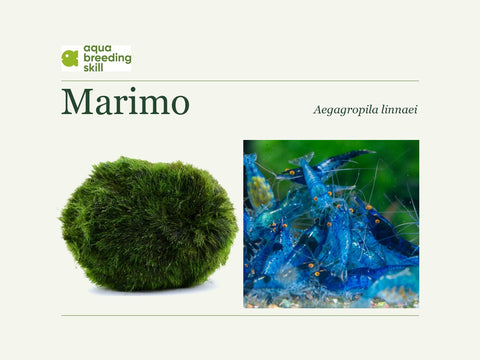
Yes — marimo and Neocaridina shrimp are an excellent match. They like the same cool, mineral-containing water, and the ball gives shrimp a large, permanently available grazing surface. But be honest about the limits: a marimo is decoration and biofilm territory, not a filter. A measurable reduction in aquarium nitrate has not been demonstrated, it will not cycle a tank, and it does not replace water changes.
Here is what the ball actually does in a shrimp tank, what it cannot do, and how to combine the two — with the usual separation of research, inference, and keeper practice.
What a marimo does for shrimp
A lasting grazing surface. A marimo is a dense sphere of living algal filaments, and research on wild marimo shows its surface carries a structured microbial biofilm.1 In an aquarium, that combination — algae filaments plus the biofilm growing on and between them — is exactly the kind of surface shrimp pick at all day. There are no controlled studies of shrimp feeding on marimo specifically, so treat this as a well-founded inference, not a measured effect: the surface is there, the biofilm is there, and shrimp graze on comparable surfaces everywhere in the tank.
Shelter for shrimplets. The loose, fluffy surface of the ball gives newborn shrimp something to climb into and under. This is keeper experience rather than published research, but it matches what we know about how shrimplets use mosses and other fine-structured surfaces.
Living decor that shrimp usually leave intact. Neocaridina generally leave healthy marimo intact — they graze on it, not through it. That makes the ball one of the few "plants" that stays intact in a shrimp colony indefinitely, needs no substrate, no fertilizer, and no CO₂, and tolerates the same conditions for decades.2
What a marimo does not do
It does not replace the filter. Ammonia and nitrite in a shrimp tank are handled by the nitrifying community of a mature biofilter — a slow-growing algal ball plays no meaningful role in that. For how the biofilter actually works and why bottled bacteria are only a support, see our article on beneficial bacteria in a freshwater shrimp tank.
A measurable reduction in nitrate has not been demonstrated. Marimo grows extremely slowly — MRI scans of large wild balls show annual rings and a diameter growth of about 12.6 mm per year under near-ideal natural conditions.3 Slow growth means small nutrient uptake. No published measurement supports the claim that a marimo ball noticeably lowers nitrate in an aquarium, so we do not make it. Your nitrate control is still plants, feeding discipline, and water changes.
It does not replace water changes or mineral balance. If anything, marimo itself appreciates the same stable, mineral-containing water your shrimp do.
Water parameters: where the two overlap
The overlap is genuinely convenient. Our working parameters for Neocaridina are pH 7.2–7.5, GH 4–8, KH 2–5 — water with some calcium and magnesium in it. Research on marimo shows a specific calcium requirement, and in the wild it only occurs in lakes with elevated mineral content.4,5 So shrimp water and marimo water are naturally the same kind of water; neither needs to be adjusted for the other.
Temperature needs a little more attention. Marimo is a cold-water alga: physiological studies found it very sensitive to heat above roughly 30 °C, and the decomposition of the ball's interior accelerates as water warms.5,6 Neocaridina are comfortable in the low twenties, which suits marimo perfectly. The practical rule: a shrimp tank at 20–24 °C keeps both happy; a tank that regularly climbs above 26–28 °C in summer is stressful for the shrimp and even more so for the ball.
| Parameter | Neocaridina (our working range) | Marimo (from research) | Compatible? |
|---|---|---|---|
| Temperature | ~20–24 °C | Cool water; damaged above ~30 °C | Yes, in the low twenties |
| pH | 7.2–7.5 | Occurs in neutral, mineral-rich lakes | Yes |
| GH / minerals | GH 4–8, KH 2–5 | Specific calcium requirement | Yes |
| Light | No special need | Shade-adapted; direct sun damages it | Yes — standard tank lighting, no sun on the glass |
| RO / distilled water | Only remineralized | Mineral-poor water is a poor fit (inference from calcium data) | Same rule for both |
How many balls per tank?
There is no scientific basis for a "balls per liter" rule, and we will not invent one. Because marimo grows so slowly, several balls barely change the nutrient balance, so the real considerations are space and looks. Practically: one small ball is a grazing spot; a group of three to five makes a visible feature on the bottom of a shrimp tank. Leave room around each ball so you can pick it up, rinse it, and roll it — the same maintenance as in a jar applies in the tank (see our marimo care guide).
Watch the neighbors, not the shrimp
The shrimp are not the risk to the ball — other tank mates are. Keepers report goldfish, crayfish, and large plant-eating fish tearing marimo apart; this is practice-level knowledge, not a tested species list, but in a mixed tank it is the first thing to watch. In a dedicated Neocaridina or Caridina tank, the ball is safe.
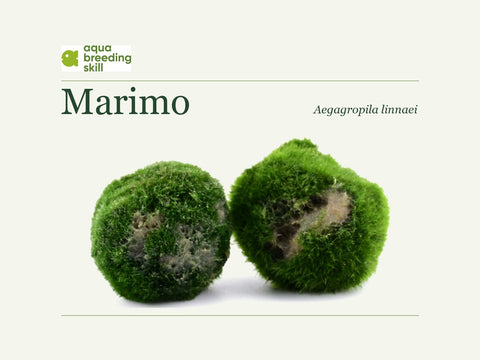
The reverse risk matters more: what arrives on the ball. In 2021, invasive zebra mussels were found inside marimo shipments in the aquarium trade, triggering recalls and tighter import checks.7 Shrimp are far more sensitive to treatments than fish, so you do not want to discover a hitchhiker after the ball is in the tank. Rinse a new marimo, inspect it, and observe it in a separate jar before introducing it to your colony. A few days of isolation cannot rule out tiny larvae. Our marimo balls are listed here: Cladophora ball (Aegagropila linnaei).
The honest summary
A marimo in a shrimp tank is a long-lived, maintenance-light piece of living decor that doubles as permanent grazing territory — valuable, but for what it is, not for imaginary filter work. Keep the water cool and mineralized, skip the direct sun, rinse and roll the ball with your water changes, and quarantine every new ball. Do that, and the ball can accompany the aquarium for years.
Sources
- Nakai R., Wakana I., Niki H. (2021). Internal microbial zonation during the massive growth of marimo, a lake ball of Aegagropila linnaei in Lake Akan. iScience 24(7):102720. sciencedirect.com
- Boedeker C. et al. (2010). Biogeography of Aegagropila linnaei. Journal of Biogeography. repository.naturalis.nl
- Nakayama K. et al. (2021). The structure and formation of giant Marimo (Aegagropila linnaei) in Lake Akan, Japan. Scientific Reports 11. nature.com
- Wakana I. (2015). Water chemistry of marimo lakes in the Akan lake group. Kushiro International Wetland Centre report. kiwc.net
- Wakana I. (2026). A century of marimo conservation research at Lake Akan (review). Sourui 74(3), Japanese Society of Phycology. sourui.org (in Japanese)
- Nakayama K. et al. (2023). Ideal water temperature environment for giant Marimo in Lake Akan, Japan. Scientific Reports 13:16834. nature.com
- U.S. Fish and Wildlife Service (2021). Invasive zebra mussels found in moss balls. fws.gov

Comments (0)
There are no comments for this article. Be the first one to leave a message!